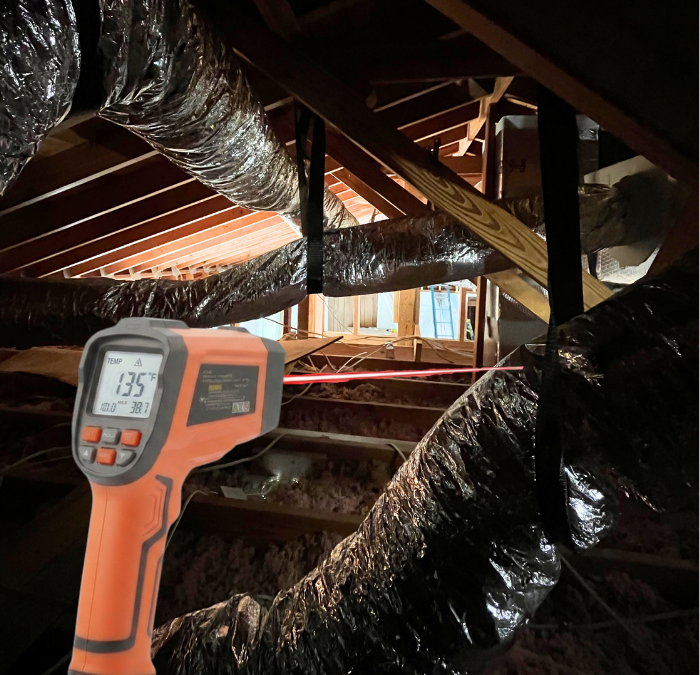
It’s 95 degrees outside in the Panhandle, but up in your roof space? It’s a completely different story.
When our White Sands technicians climb into local attics during July and August, understanding the link between attic temperature and AC efficiency in Pensacola is one of our top priorities. Thermal imaging equipment frequently reads 120°F to 140°F in unventilated roof spaces. The graphic above breaks down a reality we see every day: that red laser isn’t just measuring the air; it’s measuring the brutal environment your air conditioning equipment and ductwork have to live in every single day. If your AC seems to run continuously without ever reaching your thermostat’s set temperature, the problem might not be your unit itself, it might be the attic oven sitting directly above your ceiling.
Your roof acts like a giant solar collector. Dark asphalt shingles absorb radiant heat from the Florida sun all day long, trapping that thermal energy inside your attic space.
When your attic hits 120°F+, it creates three major problems for your HVAC system:
Your air handler works hard to freeze your air down to roughly 55°F. That cold air then travels through flexible ductwork routed directly through your 120 degree attic. Even with insulation wrapped around those ducts, radiant heat bleeds through the outer jacket, warming the air before it ever reaches your living room.
According to the Department of Energy, the average home loses 20% to 30% of its conditioned air through tiny gaps, loose seals, or tears in attic ductwork.
Your indoor unit’s motor and sensitive electronics are constantly operating inside this extreme ambient temperature. High heat increases electrical resistance, forcing blower motors to draw more amperage, accelerating wear and tear, and drastically increasing the risk of a mid-summer capacitor blowout.
| Symptom | What It Means |
| Non-Stop Running (3 PM – 7 PM) | The thermal load from the attic is entering your home faster than the AC can remove it. |
| Warm Air From Vents Upstairs | Long duct runs traveling through peak attic heat are warming up before reaching the room. |
| A Massive FPL Bill Spike | Your compressor is pulling maximum power continuously just to hold a baseline temperature. |
You can’t change the Florida summer, but you can change how your attic handles the heat:
Don’t let attic heat drain your wallet or destroy your cooling equipment this summer. As part of our 50+ Point Health Report, White Sands technicians inspect your duct connections, check airflow temperatures, and test system static pressure to maximize your system’s output.
Is your system struggling to hold temperature today? Call White Sands Cooling and Heating at (850) 932-9800 to schedule your system evaluation!

Warning: Our online payment system will accept payment for invoices for other companies. In fact, there is an electrical company in our area named "White Sands Electric." We are "White Sands Cooling & Heating" and are a completely separate, unrelated entity. By clicking the "Proceed to Payment" button below, you acknowledge that you are making a payment to "White Sands Cooling & Heating." Errors will result in a processing fee.