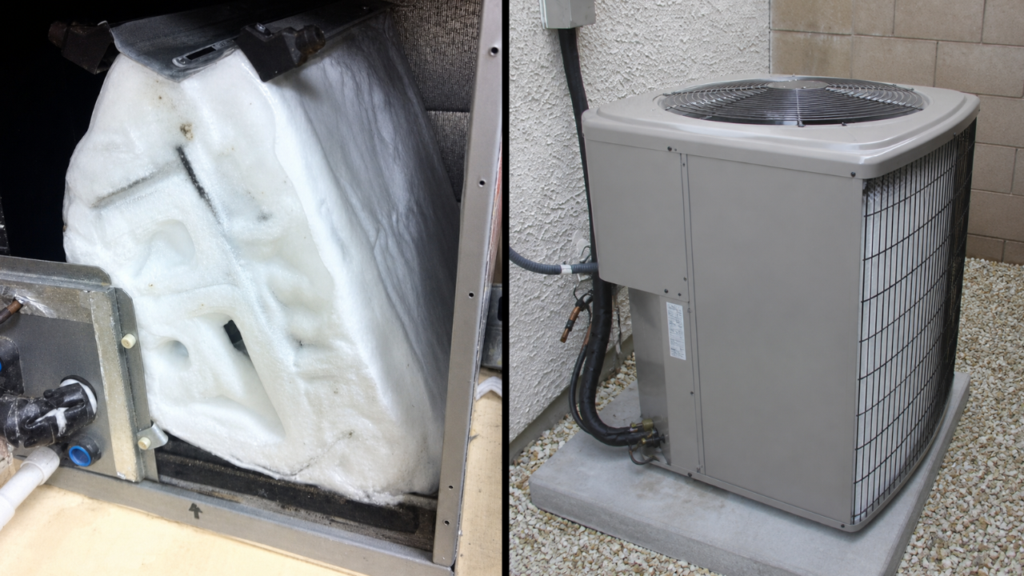
It’s the middle of July in the Florida Panhandle. The afternoon sun is beating down on Pensacola, the humidity is thick enough to chew, and the outdoor temperature is holding steady at a brutal 95 degrees. You walk inside to escape the heat, only to realize the house feels warmer than it should.
You walk over to your indoor air handler or look out at your outdoor condenser unit, and you can’t believe your eyes. In the dead of summer, your cooling system is completely encased in a thick block of solid white ice.
It sounds completely backward, doesn’t it? How can a machine designed to operate in extreme heat literally turn itself into an ice maker?
At White Sands Cooling and Heating, we see a massive spike in a frozen AC unit in Pensacola during the peak summer months. It is one of the most common—and misunderstood—mid-summer breakdowns. If you are staring at a block of ice inside your utility closet today, don’t panic. Here is the exact breakdown of why this happens, how to fix it, and how to protect your wallet.
To understand why your system froze over, you have to look at how your AC handles our thick Florida humidity. Your system relies on a chemical refrigerant flowing through an indoor coil (the evaporator coil). As warm, moist air from your home is blown across this cold coil, the coil absorbs the heat and wrings out the moisture.
However, if the system’s delicate balance is disrupted, the temperature of that coil will drop below freezing (32°F). The moisture pulled from your home’s air will instantly turn to frost, layering over itself until the entire coil is choked by ice, completely blocking any airflow into your home.
When a system turns into an iceberg in July, it almost always comes down to one of two major mechanical issues:
Your AC needs a massive, constant stream of warm household air to keep the freezing refrigerant inside the coils warm enough to stay above freezing. If that airflow drops, the temperature crashes.
It sounds counterintuitive, but a lower amount of refrigerant actually causes the pressure inside the evaporator coil to drop. Lower pressure means a much lower temperature. If your system has a small, undetected pinhole leak from salt air corrosion, the dropping pressure will cause the remaining refrigerant to boil at a sub-freezing temperature, rapidly expanding into a block of ice.
If you discover a frozen AC unit in Pensacola, turning the thermostat down lower will only cause severe, permanent damage to your compressor. Instead, follow these three steps immediately:
| Step | Action Required | Why It Matters |
| Step 1 | Turn the System OFF | Stop the cooling cycle immediately to halt further ice accumulation. |
| Step 2 | Flip Fan to “ON” | Change the fan setting from “Auto” to “ON” to force warm air across the ice and melt it safely. |
| Step 3 | Check Your Filter | Pull the indoor filter out. If it’s gray, fuzzy, or completely blocked, replace it immediately. |
Do not attempt to scrape or hack the ice off the coils with a knife or sharp tool. The aluminum fins and copper lines are incredibly delicate; a single nick can puncture a refrigerant line, turning a simple issue into an expensive replacement. Let nature and the fan do the work.
If you replace a filthy air filter, let the system completely thaw out for a few hours, turn it back on, and it freezes right back up—you have a refrigerant leak or a failing blower motor.
Running a frozen unit can liquid-flood your compressor, destroying the heart of your system. Our team at White Sands can perform an emergency inspection, trace any microscopic refrigerant leaks using advanced electronic leak detectors, and get your system perfectly balanced again.
If the math points toward an upgrade rather than a costly repair on an aging system, remember that we provide flexible paths forward through our trusted partners, Wells Fargo and GoodLeap, allowing you to get a brand-new, high-efficiency SEER2 system installed with $0 down and low monthly payments.
Don’t let a frozen system ruin your summer comfort. Call White Sands Cooling and Heating today at (850) 932-9800 to schedule your fast, honest diagnostic!

Warning: Our online payment system will accept payment for invoices for other companies. In fact, there is an electrical company in our area named "White Sands Electric." We are "White Sands Cooling & Heating" and are a completely separate, unrelated entity. By clicking the "Proceed to Payment" button below, you acknowledge that you are making a payment to "White Sands Cooling & Heating." Errors will result in a processing fee.